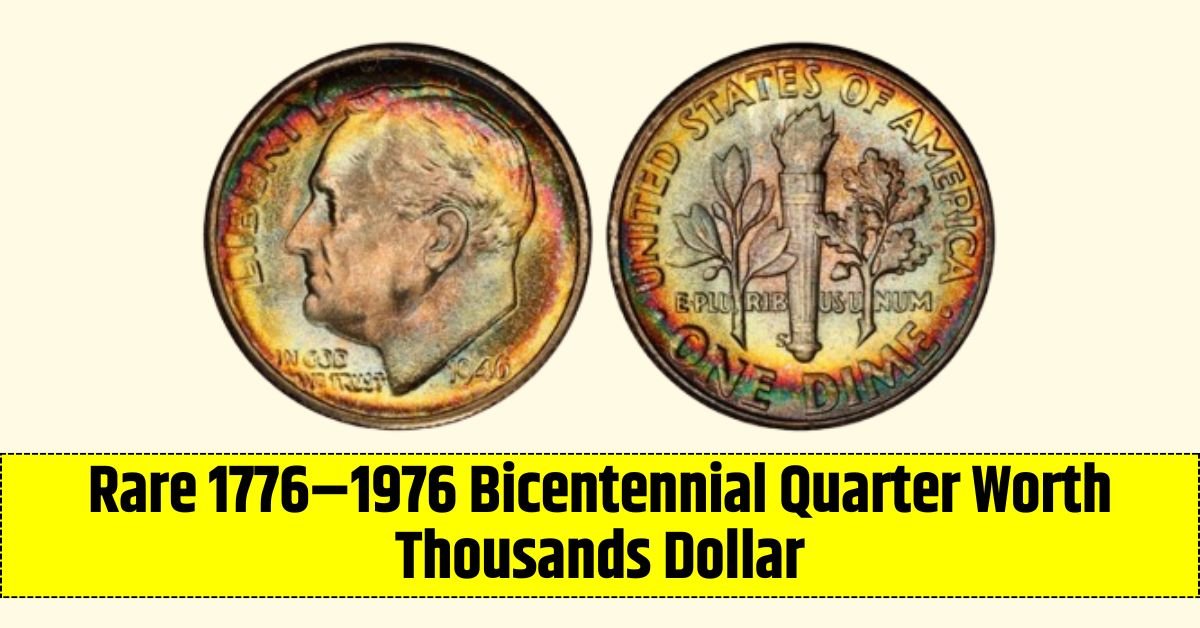

The 1776–1976 Bicentennial Quarter holds a special place in American coinage not just for its patriotic design, but for the mystery, excitement, and rare gems it’s brought into the numismatic world. Celebrating 200 years of U.S. independence, this quarter was minted in such massive quantities that you’d think there’s no way any of them are worth more than face value. And yet… a few are. A select handful of error coins and high-grade specimens have fetched thousands of dollars—and in rare cases, rumors of six-figure or million-dollar private sales swirl around the hobby.
So how do you know if your 1976 quarter is worth 25 cents or $2,500?
Let’s break it down.
The Bicentennial Quarter at a Glance
| Feature | Details |
|---|---|
| Years Minted | 1975–1976 (but all are dated 1776–1976) |
| Obverse | George Washington (same as standard quarter) |
| Reverse | Colonial drummer with victory torch & stars |
| Designer | Jack L. Ahr (reverse) |
| Mint Marks | P (no mark), D (Denver), S (San Francisco) |
| Purpose | Celebrate America’s Bicentennial (1776–1976) |
| Total Mintage | Over 1.6 billion across all types |
You’ll find these coins everywhere: in junk drawers, in estate collections, or still floating through circulation today. Most are common. But a few? Not so much.
Why Some Bicentennial Quarters Are Worth Thousands
Let’s be honest: most Bicentennial quarters are just coins. They’re not rare, they’re not silver (unless specially minted), and they’re not going to retire you. But a tiny subset—thanks to striking errors, rare compositions, or immaculate condition—can bring serious money.
1. Minting Errors That Boost Value
Some of the most valuable Bicentennial quarters involve errors during production:

| Error Type | What It Means | Value Range |
|---|---|---|
| Doubled Die | Doubling of letters or details (drummer) | $250 – $3,000+ |
| Off-Center Strike | Design isn’t centered on the coin | $100 – $1,500+ |
| Wrong Planchet | Coin struck on dime or foreign blank | $500 – $5,000+ |
| Mule Error | Mismatched obverse/reverse dies used | Up to $100,000+ |
These aren’t your average circulation coins. A mule error—where the Washington obverse was paired with the wrong reverse—has only surfaced a few times in U.S. coin history and fetches enormous premiums at auction.
2. Silver-Clad Quarters
Here’s where it gets tricky. The U.S. Mint did produce 40% silver Bicentennial quarters, but only in special collector sets—not for general circulation.
- Found only in 1976-S Silver Uncirculated Sets and Proof Sets
- These have solid silver edges (no copper stripe)
- If you find one in circulation, it could be worth $4–$10 or more, depending on grade
But even rarer are silver quarters with planchet or striking errors—those can command thousands.
3. High-Grade Coins (MS69–MS70)
Coins graded MS68+ or PR70DCAM (proof) by PCGS or NGC are ultra-rare. Most quarters from circulation don’t grade higher than MS65.
A perfect MS70 silver Bicentennial quarter once sold for over $5,000, and auction results continue to support strong pricing for pristine examples.

How to Identify a Rare Bicentennial Quarter
You don’t need a microscope or a numismatic degree—but you do need to pay close attention. Here’s how:
Step-by-Step Guide
| Step | What to Check For | Tool Needed |
|---|---|---|
| 1 | Check the Edge | Your eyes |
| Solid silver = possible silver issue | ||
| 2 | Magnify Details | 10x loupe or phone macro lens |
| Look for doubling on “LIBERTY,” date | ||
| 3 | Check Weight | Digital scale (grams) |
| Silver coin: ~5.75g vs clad: ~5.67g | ||
| 4 | Inspect for Centering | Visual |
| Off-center strikes can mean big value | ||
| 5 | Mint Mark | Small “D,” “S,” or none |
| “S” indicates proof or silver issue |
If something seems off—or spectacular—don’t clean the coin. Just document it and consider sending it to PCGS or NGC for verification.
Could One Still Be in Circulation?
In a word: yes. But…
It’s rare. That’s what makes it exciting.
You’re more likely to find:

- Regular clad coins in worn condition
- Silver coins mistakenly spent from old collections
- Lightly circulated high-grade coins (uncertain value until graded)
Why Valuable Coins Might Still Appear
- Estate collections being cashed in
- Old rolls of coins opened and spent
- Inherited collections misunderstood by heirs
- Garage sale or flea market finds
Bottom line: finding one is low probability—but not zero. And with over 1.6 billion out there, the thrill of the hunt is half the fun.
Collector Tips to Spot and Store the Good Stuff
Whether you’re a beginner or deep into the hobby, here are a few timeless tips:
- Never clean a coin — Cleaning can remove natural toning and lower grade.
- Use non-PVC flips or holders — These protect without damaging.
- Compare with known error listings — Reference PCGS CoinFacts or auction archives.
- Join a coin club or online group — Collective knowledge helps verify potential finds.
- Document everything — Especially if you plan to grade or sell it.
The 1776–1976 Bicentennial Quarter is more than just a coin—it’s a piece of living American history, commemorating the nation’s founding while still floating through daily life nearly 50 years later. While most are worth only face value, a few rare varieties—thanks to errors, silver composition, or pristine condition—can turn that humble quarter into a payday.
Could one be sitting in your pocket or coin jar? Maybe. You won’t know unless you look.
So grab a loupe, sort your change, and chase the next great find. You might just strike numismatic gold.

FAQs
Check the edge if it lacks a copper-colored stripe and has a solid silver appearance, it may be a 40% silver collector issue.
Some rare error coins and high-grade silver proofs have sold for $5,000–$10,000+. Unconfirmed reports of mule errors reach even higher.
No. Cleaning can damage the surface and reduce collector value. Keep it in original condition.
Send it to a reputable grading service like PCGS, NGC, or ANACS for certification and evaluation.
It’s rare, but yes, especially from older estates, jars, or roll hunting. Be vigilant and check the edges and details.
