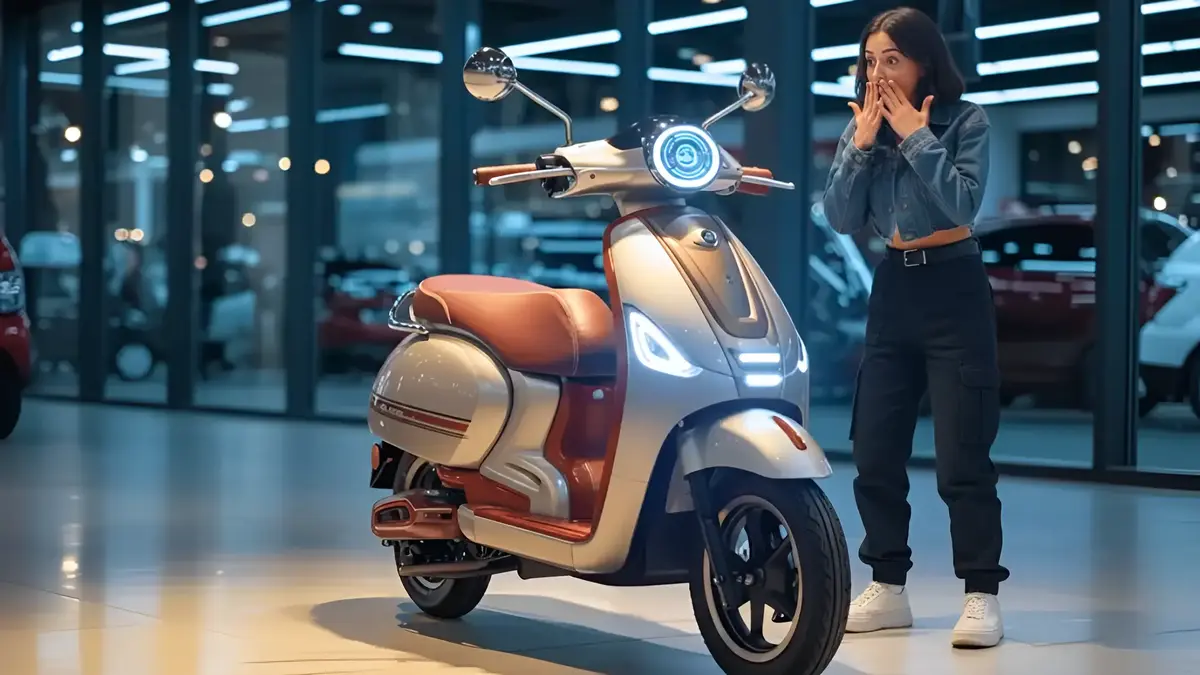

The Chetak electric scooter has become one of those rare machines that manage to feel nostalgic and futuristic at the same time. You spot one gliding through a quiet lane, its LED horseshoe headlamp glowing like a subtle reminder of the old Chetak legacy, and yet the silent electric motor instantly tells you this is a very different beast. In a market crowded with EVs some flashy, some functional the Chetak feels almost… composed. Like it knows exactly what it wants to be.
Design & Build Quality
Let’s start with the obvious: the Chetak looks premium. Not in a loud, attention-seeking way, but in a clean, European-scooter sense. The metal body panels give it a sturdier presence than the typical plastic-heavy EVs, and the paint quality a detail many buyers overlook is honestly top-tier for the segment.
The curved panels, flush-fit components, and the signature front fascia create a kind of minimalist elegance. The seat is wide, the tail section is sculpted, and the fit-and-finish feels almost too refined for something in the sub-₹1.5 lakh bracket.
If you’ve ever ridden the classic Bajaj Chetak from the pre-2010 era, this one doesn’t try to mimic it. Instead, it pays homage with subtle cues while keeping everything modern.
Motor, Power Output & Riding Feel
The Chetak is powered by a 3 kWh battery paired with a mid-mounted motor delivering around 4.2 kW of peak power. On paper, it may not seem as aggressive as some performance-oriented EVs out there. But the scooter isn’t trying to win drag races. It’s engineered for smooth, predictable city riding.
Acceleration is linear no sudden jerks, no unpredictable surges. In Eco mode, it feels calm and composed, perfect for bumper-to-bumper traffic. Switch to Sport mode, and it becomes noticeably livelier, giving you better pull at mid speeds.
Here’s a quick peek at the powertrain:

| Specification | Chetak Electric |
|---|---|
| Battery | 3 kWh |
| Motor | 4.2 kW peak |
| Range | 108–127 km (claimed) |
| Top Speed | ~63 kmph |
| Drive Type | Mid-drive motor |
| Riding Modes | Eco, Sport |
It’s not the fastest electric scooter in the country, but it may be one of the most refined in terms of throttle response and stability.
Real-World Range & Charging Time
This is where the Chetak has surprised a lot of buyers. While the company claims a triple-digit range, the real-world numbers depending on city traffic and riding habits fall comfortably between 85 and 110 km on a full charge.
For most urban riders, that means charging roughly every 2–3 days.
Charging is straightforward: plug it into a regular home socket. A full charge usually takes around 4–5 hours.
And perhaps the biggest W for Chetak is battery longevity. Bajaj’s nickel–manganese battery chemistry seems to hold up better than many competitors after years of daily use. Fewer range drops. Fewer surprises.
Ride Comfort & Handling
The suspension setup on the Chetak is tuned for Indian roads read: it’s designed to handle the kind of potholes that pop up overnight after a drizzle. The front single-sided suspension looks stylish but also works well for city riding.

The overall ride quality feels well-balanced. Not too soft. Not too bouncy. Just right for daily commutes.
Handling is another highlight. The scooter feels planted at higher speeds and surprisingly stable on turns. The larger wheels give it a confident grip, and the weight distribution helped by the mid-mounted motor improves overall balance.
Features & Tech
Bajaj didn’t cram the Chetak with flashy features just for marketing. Instead, they took the practical route:
- LED headlamps and indicators
- All-digital display
- Reverse assist
- Regenerative braking
- App connectivity with ride stats
- Geo-fencing and anti-theft features
- Keyless operation (in newer variants)
The screen isn’t fancy or overly bright, but it’s clean and gets the job done. The connected features feel more functional than gimmicky. And the “feels-like-metal-everywhere” finish gives the scooter a premium physical presence many EVs lack.
Braking & Safety
The braking setup a disc at the front and drum at the rear offers reliable stopping power for everyday riding. The regen system is mild but adds a bit of battery recovery during slowdowns.
The scooter holds its line well during hard braking, and the grip from the tyres feels reassuring even on less-than-perfect streets.

Pricing & Variants
Depending on the city and variant, the Chetak typically falls around the ₹1.30 lakh to ₹1.45 lakh (ex-showroom) range. Not the cheapest in the EV market, especially with aggressive pricing from some newer brands.
But what you pay for is reliability, brand backing, stronger engineering, and a build that feels built-to-last.
The price includes the government incentives under the updated EV policy, but after recent subsidy revisions, on-road prices vary a bit more state-to-state.
Ownership Cost & Maintenance
One of the biggest perks? The Chetak barely asks for maintenance. There’s no engine oil, no air filter drama, no clutch issues. Service visits are minimal, and Bajaj’s dealership coverage is a huge advantage compared to newer EV startups still building their service network.
Consumables like brake pads and tyres might need attention eventually, but overall, running costs remain impressively low.
Final Verdict
The Chetak electric scooter is not here to break speed records or drown you in gadgetry. It’s here to offer a solid, premium, fuss-free riding experience that feels dependable not experimental.

If you want an EV that:
- Looks classy
- Feels premium
- Rides smooth
- Offers stable real-world range
- And comes from a brand with decades of trust
…then the Chetak should absolutely be on your shortlist.
In a space where many electric scooters try to scream for attention, the Chetak whispers and somehow says a lot more.
FAQs
Most riders get 85–110 km depending on traffic, riding mode, and rider weight.
Roughly 4–5 hours from a standard home socket.
Yes, absolutely. The smooth throttle, comfortable ride, and efficient range make it ideal for urban use.
Currently, no. It charges through a standard home outlet.
It can handle moderate distances, but long touring isn’t its primary purpose due to range limits.
