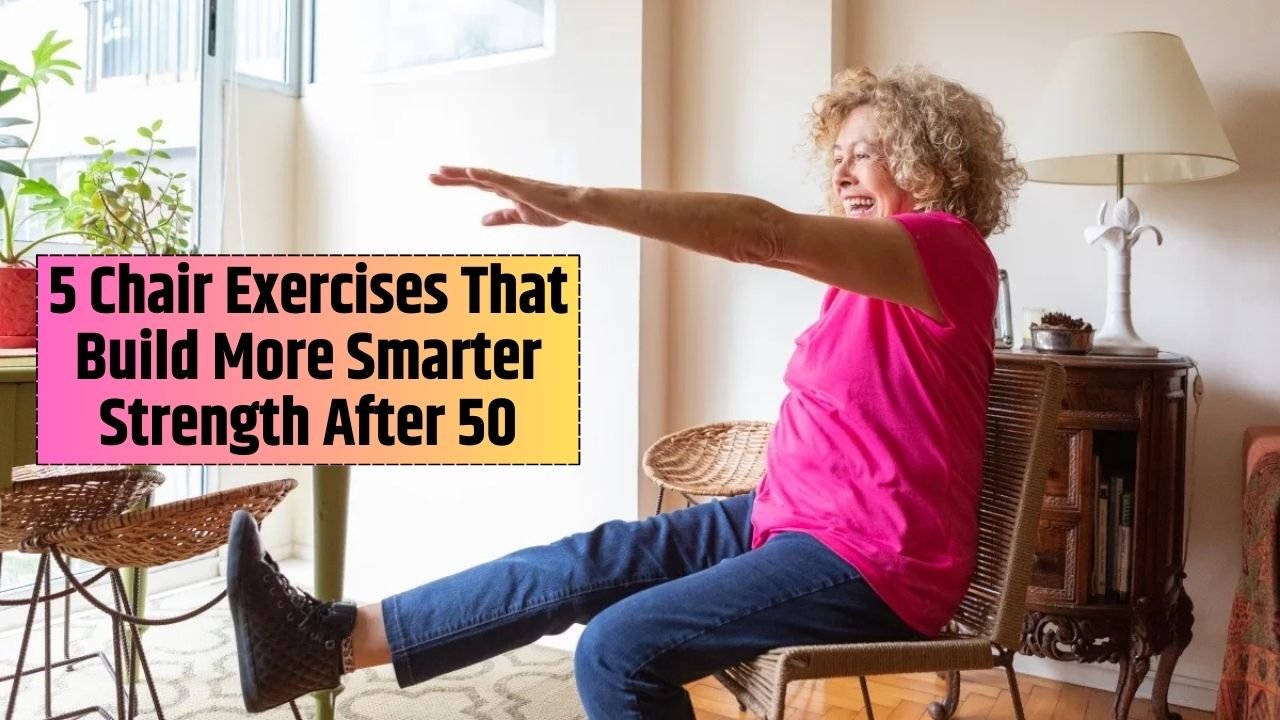

Strength after 50 doesn’t look like it used to and that’s a good thing. Back in the day, fitness culture told us that more weight equals more strength. Gym memberships, bench press numbers, and heavy squats were the gold standard. But when your knees start grumbling, your back tenses up more than it used to, and you’re not recovering like you did in your 30s? That same formula starts to fall apart.
The truth is, functional strength the kind that helps you get up off the floor, climb stairs without holding on, carry groceries, or catch your balance — becomes the real MVP as we age. And surprisingly? Chair exercises might do a better job building that kind of strength than weights ever could.
Let’s unpack why that is, and how to train smarter — not harder — after 50.
Why Chair Exercises Can Be More Effective Than Weights After 50
It’s not that lifting weights is bad — it’s that it stops being the only answer as we get older. The priorities shift. You want to stay mobile, avoid injury, and keep doing what you love — pain-free.
Here’s what chair-based strength training offers:
| Benefit | Why It Matters After 50 |
|---|---|
| Time under tension | Slower, controlled movement builds deeper strength |
| Joint-friendly | Reduces impact on knees, hips, and spine |
| No cheating | Forces better form and full-body engagement |
| Improves balance | Key to avoiding falls and injury |
| Faster recovery | Enables consistent training without burnout |
| Functional strength | Mimics real-life movements — sitting, standing, reaching, stabilizing |
And let’s be clear: this isn’t “easy” training. It’s intelligent training.
Exercise 1: Chair Sit-to-Stand (Slow Tempo Squats)
What it builds:
Glutes, thighs, hips, and core stability
Why it matters:
The ability to rise from a seated position is one of the biggest predictors of independence later in life. This movement strengthens exactly that — without compressing the spine or jarring the knees.
How to do it:
- Sit near the edge of a sturdy chair, feet shoulder-width apart
- Cross arms over chest (or reach forward for balance)
- Slowly stand up over 3–4 seconds — no hands, no momentum
- Pause at the top, then lower down over 3–4 seconds
Repeat for 8–10 reps. Rest, then repeat.
Why it works:
This builds real leg strength, trains balance, and improves coordination. Slow tempo = more muscle engagement. No gym required.
Exercise 2: Seated Leg Extension Holds
What it builds:
Quadriceps, knee support
Why it matters:
If stairs or long walks aggravate your knees, this is your new best friend. Isometric strength (holding without movement) improves joint support without wear and tear.
How to do it:
- Sit tall with feet flat on the floor
- Extend one leg straight until your foot is off the ground
- Squeeze your thigh muscle hard and hold for 20–40 seconds
- Slowly lower, switch sides
Why it works:
You’re strengthening the exact muscles that stabilize your knees — with zero impact. Plus, you can do this while watching TV.
Exercise 3: Chair-Assisted Single-Leg Squats
What it builds:
Unilateral leg strength, hip stability, balance
Why it matters:
One-sided strength = real-world strength. Walking, stair climbing, catching yourself from a fall — all depend on single-leg control.

How to do it:
- Stand in front of your chair
- Lightly place one foot behind you on the chair
- Lower down on your standing leg until your hips just touch the chair
- Stand back up slowly
8 reps per leg. Use a wall or counter for light balance assistance if needed.
Why it works:
No heavy weights, but intense activation. You’ll quickly feel which side is weaker — and start fixing it.
Exercise 4: Seated Overhead Press (No Weights)
What it builds:
Shoulders, upper back, posture muscles
Why it matters:
Overhead strength and mobility often decline with age — and heavy dumbbells can stress fragile joints. This version activates stabilizers without strain.
How to do it:
- Sit tall, ribs down, core tight
- Raise arms to shoulder height, elbows bent
- Slowly press arms overhead — imagine pushing against resistance
- Pause at the top, lower slowly
Repeat for 10–12 reps, focusing on slow control.
Why it works:
You’re teaching your body to control movement through the full range, not just lift weight. That improves posture, reduces tension, and strengthens where you’re weak.

Exercise 5: Chair Plank Holds
What it builds:
Core, shoulder stability, glutes
Why it matters:
Core strength isn’t about six-pack abs — it’s about protecting your spine, supporting your posture, and preventing falls. Chair planks are safer and just as effective.
How to do it:
- Place your hands on the edge of the seat
- Step your feet back into a plank (body in a straight line)
- Squeeze glutes, tighten core, and hold for 20–60 seconds
Progressions: Lift one leg, tap opposite shoulder, or do it on forearms for added difficulty.
Why it works:
It’s the safest way to train the core for real-life strength — without hurting your back.
Sample Chair Strength Workouts (WODs) for Over 50
Chair WOD 1: Total-Body Builder
Time: 15 minutes
Format: AMRAP (As Many Rounds As Possible)
- 10 Slow Sit-to-Stands
- 20s Leg Extension Hold (each leg)
- 10 Seated Overhead Presses
- 30s Chair Plank
Repeat as many rounds as possible. Rest only when needed.
Chair WOD 2: Leg & Balance Focus
Time: 12 minutes
Format: EMOM (Every Minute on the Minute)
- Minute 1: 8 Single-Leg Squats (Right Leg)
- Minute 2: 8 Single-Leg Squats (Left Leg)
Alternate for full 12 minutes.
Chair WOD 3: Core & Stability Circuit
Time: 10–15 minutes
Format: Timed Circuit
- 40s Chair Plank
- 20s Rest
- 30s Seated Leg Extension Hold
- 20s Rest
Repeat for 3–5 rounds.
How Often Should You Train?
Consistency matters more than intensity. Unlike heavy lifting, chair-based strength work doesn’t crush your joints, so you can train more often.
Weekly Plan:
| Day | Focus |
|---|---|
| Monday | Chair WOD 1 |
| Tuesday | Mobility or light walk |
| Wednesday | Chair WOD 2 |
| Thursday | Rest or gentle stretching |
| Friday | Chair WOD 3 |
| Saturday | Walk or recreational movement |
| Sunday | Optional rest day |
That’s 3 strength sessions per week, with flexibility built in.
There’s nothing wrong with lifting weights. But if the old way of training is causing pain, frustration, or inconsistency — it’s time to let go of old rules and focus on what works now.
Chair exercises aren’t a step down. They’re a step forward — toward a stronger, safer, more functional body that ages well.
Because at the end of the day, it’s not about how much you lift.
It’s about how well you live.
