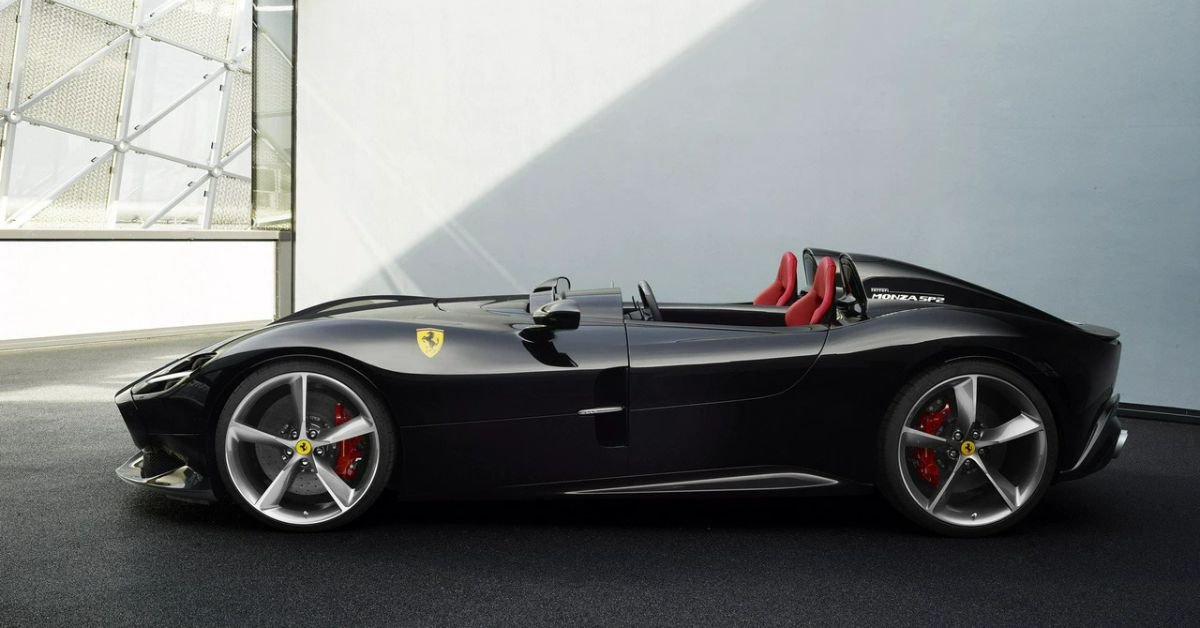

A car without a roof, without a windscreen, and absolutely without compromise that’s the Ferrari Monza SP. It’s not a car you drive; it’s a car you experience. The moment you see it, you realize this isn’t about comfort or convenience. It’s a nod to Ferrari’s golden age of racing — a machine that celebrates freedom, speed, and raw emotion.
The Monza SP feels less like an automobile and more like a sculpture in motion, one that happens to do over 300 km/h.
A Tribute to Ferrari’s Racing Heritage
The Monza SP carries a name drenched in history. “Monza” isn’t just a racetrack — it’s a temple of speed. Back in the 1950s, Ferrari’s race cars like the 166 MM, 750 Monza, and 860 Monza tore through circuits like Monza and Mille Miglia, cementing the brand’s legend in motorsport.
The Monza SP is Ferrari’s modern-day salute to those machines. It channels that era’s raw racing spirit but reinterprets it through today’s technology and design sophistication. The result? A car that looks straight out of a classic poster but performs like a 21st-century missile.
Design – The Return of the Barchetta
Ferrari calls it a barchetta, Italian for “little boat,” and it fits perfectly. The Monza SP strips away the unnecessary — no roof, no traditional windshield, no frills. The result is one of the most striking silhouettes ever created in Maranello.
Instead of a windshield, Ferrari engineers designed a clever “Virtual Windshield.” It’s a small aerodynamic deflector that channels airflow over the driver’s head, keeping turbulence surprisingly manageable even at high speeds. Imagine the wind streaming past you while the car feels as stable as a jet.
Built almost entirely from carbon fiber, the Monza’s body weighs next to nothing, helping it maintain a power-to-weight ratio that borders on the insane. The sculpted fenders, razor-sharp creases, and classic long-hood proportions pay homage to Ferrari’s racing past, while modern aerodynamics keep it glued to the tarmac.

It’s one of those designs that’ll look just as breathtaking 50 years from now — because beauty like this doesn’t age.
Engine – The Heart of a Ferrari
Under that impossibly long hood lies a naturally aspirated 6.5-litre V12 engine — an evolution of the one used in the Ferrari 812 Superfast. Ferrari tuned it to unleash 810 horsepower and 719 Nm of torque.
Here’s what that means when you put your foot down:
| Metric | Performance |
|---|---|
| 0–100 km/h | 2.9 seconds |
| 0–200 km/h | 7.9 seconds |
| Top Speed | Over 300 km/h |
This engine doesn’t whisper; it wails. The sound is unfiltered — no turbos to muffle the symphony, no roof to block the resonance. You hear the intake growl, the mechanical clatter, and the spine-tingling exhaust note echoing off every wall and tunnel.
It’s mechanical purity — a reminder of what engines used to sound like before the world went hybrid and quiet.
SP1 vs SP2 – One Seat or Two?
Ferrari built two variants of the Monza SP:

| Variant | Description | Seating |
|---|---|---|
| SP1 | Single-seater for purists | 1 seat |
| SP2 | Twin-seat version with same performance | 2 seats |
The SP1 is the rawer, purer expression — just the driver and the machine. It’s a private dialogue at 300 km/h. The SP2, meanwhile, offers the same performance but adds a second seat so you can share the madness — or at least try to.
Both variants retain the same power figures, same design DNA, and the same heart-pounding driving feel.
The Driving Experience – Back to the Fifties
Climb in — or more accurately, drop into — the driver’s seat, and you’ll instantly feel how different this car is. No infotainment system. No air-conditioning. No power adjustments. It’s just you, the V12, and the open air.
The steering is precise, the throttle razor-sharp. Every vibration, every gust of wind, every engine pulse reaches you unfiltered. It’s as analog as modern cars can get — a time capsule that just happens to be built with 21st-century materials.
On the move, the car feels alive. Every shift, every downforce adjustment, every flick of the steering wheel reminds you that you’re piloting something that was engineered for passion, not practicality.
Driving the Monza SP isn’t relaxing — it’s exhilarating. It’s not something you use; it’s something you celebrate.

Exclusivity and Price
Of course, something this special doesn’t come easy. The Ferrari Monza SP starts around ₹15 crore (roughly $2 million USD), and even that number doesn’t guarantee you one. Ferrari handpicked its buyers from an elite list of loyal customers.
Only 499 units were ever made globally — combining both SP1 and SP2. India, with its unpredictable weather and infrastructure, saw very few allocations, making it one of the rarest Ferraris to ever touch Indian soil.
This isn’t a daily driver; it’s a collectible masterpiece. Most owners will probably never rack up serious mileage — the Monza SP is more likely to live under soft lights in private garages, occasionally roaring to life for the perfect Sunday drive.
Why the Monza SP Matters
The Monza SP isn’t about performance figures — though they’re jaw-dropping. It’s about emotion. In a world rapidly shifting to electric motors and digital dashboards, this car is Ferrari’s bold statement that heritage still matters.
It proves that even in the future, there will be room for passion, noise, and imperfection — the very things that make driving beautiful.
For collectors, it’s a unicorn. For Ferrari, it’s a love letter to its own past. And for the lucky few who’ll ever drive one, it’s probably the closest thing to flying on four wheels.

FAQs
It exceeds 300 km/h, depending on road and track conditions.
Ferrari built only 499 units worldwide, combining both SP1 and SP2.
Approximately ₹15 crore, though official allocations were extremely limited.
SP1 is a single-seater for purists; SP2 adds a second seat with the same performance.
No, it has no roof, no windscreen, and no AC — it’s a pure, open-top driving experience.
