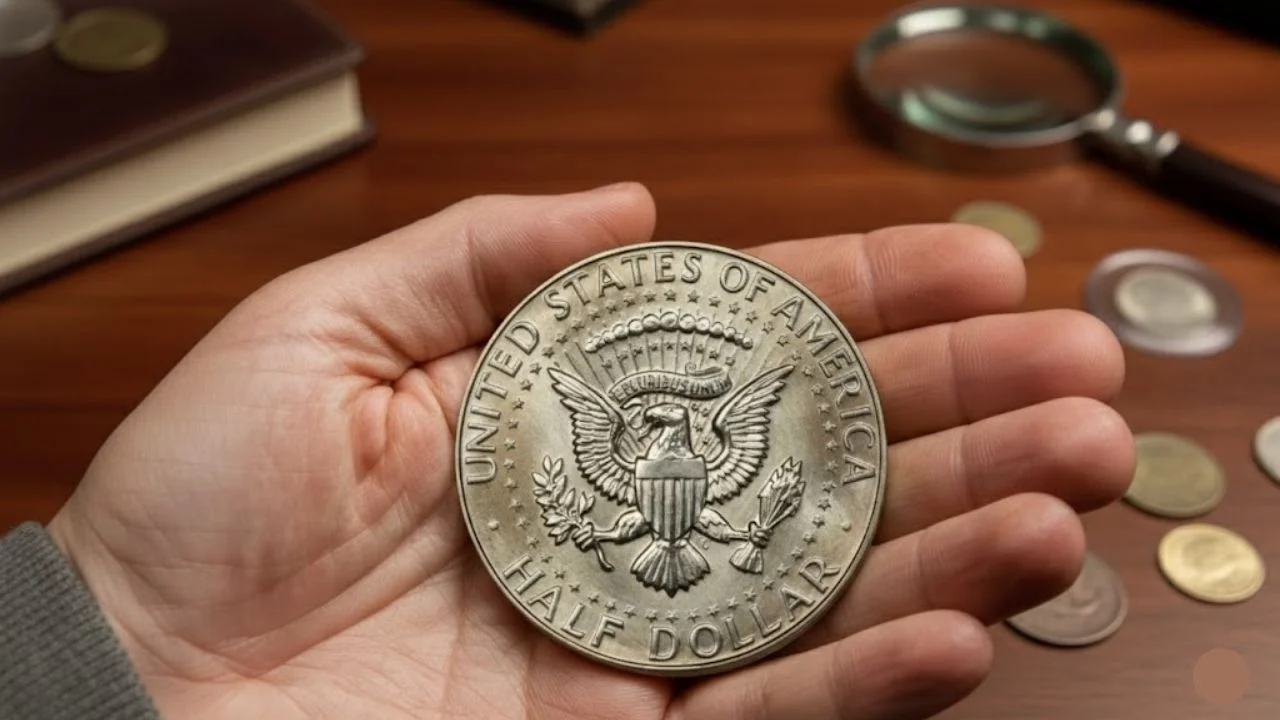

In the world of U.S. coinage, few designs carry the emotional weight and evolving complexity of the Kennedy half dollar. Born in the wake of tragedy in 1964, this coin was more than a denomination it was a national tribute. Over the decades, as the half dollar quietly faded from everyday use, it found new life in the hands of collectors, who began to uncover just how rich and nuanced this series really is.
Though the average Kennedy half may only be worth face value, a handful stand out—not just for their scarcity, but for the stories they tell. From early silver strikes to overlooked modern oddities, these seven rare Kennedy half dollars highlight the depth and drama that collectors cherish.
1964 Kennedy Half Dollar
The very first Kennedy half dollar, released just months after JFK’s assassination, was struck in 90% silver, giving it intrinsic value even before its numismatic allure is considered.
With over 430 million minted between the Philadelphia and Denver Mints, these aren’t exactly rare—but high-grade, uncirculated examples, especially from original government packaging, carry notable premiums.
Why it matters: It’s the coin that started it all—equal parts tribute and artifact. It also holds the highest silver content of any Kennedy half made for circulation.
Collector Tip: Look for strong luster and minimal contact marks. MS66+ examples can fetch $100 or more, and pristine proofs even higher.
1964-S Proof
Proof coins from San Francisco in 1964 were struck with care, designed not for circulation, but for presentation and preservation. Their surfaces are flawless—or meant to be—and feature a stunning contrast between frosted designs and mirrored fields.

What makes it rare isn’t low mintage (nearly 4 million were made)—it’s condition. A 1964 proof without a single hairline or haze is increasingly hard to find.
Collector Tip: Seek out PR68–PR70 Deep Cameo (DCAM) coins. Prices jump sharply between these grades, with top examples reaching several hundred dollars or more.
1970-D Kennedy Half Dollar
Here’s where it gets interesting. In 1970, no Kennedy half dollars were released into general circulation. The Denver Mint did produce a limited batch just over 2.1 million but they were only included in Mint Sets sold to collectors.
This makes the 1970-D a genuine circulation rarity. If you happen to find one in a roll or change jar, you’ve stumbled onto a low-mintage anomaly.
Collector Tip: Even circulated 1970-D halves are worth $10–$20, while uncirculated versions in Mint State can exceed $50–$100+.
1970-S Small Date Proof
Among the 1970-S proof halves, eagle-eyed collectors have identified a “Small Date” variety—where the numbers in “1970” appear more compact than usual. It’s a classic example of a variety that escaped casual notice, only to gain value through collector scrutiny.

It doesn’t scream rarity—but for those in the know, spotting a Small Date is a point of pride.
Collector Tip: Compare numeral shapes carefully. Specialized guides and coin forums offer side-by-side visuals. Value varies, but clean PR66–PR68 examples may command double or triple standard proof pricing.
1976-S Bicentennial Silver Proof
In 1976, the U.S. celebrated its Bicentennial with special coinage, including the dual-dated “1776–1976” Kennedy half. Most were copper-nickel, but San Francisco produced a 40% silver proof version in limited collector sets.
The design features Independence Hall on the reverse—a departure from the Presidential Seal—and is the only circulating Kennedy half to carry a non-standard reverse.
Collector Tip: Spot the difference by examining the edge: silver coins have a solid, silvery edge, while clad versions show a brownish copper stripe. Proofs with no wear and strong cameo contrast are valued at $15–$50+, depending on grade.
1987-P & 1987-D
By the 1980s, half dollars were practically absent from wallets and registers. In 1987, the Mint didn’t even bother releasing Kennedy halves to the public—they were struck only for collector sets, with mintage under 3 million per mint.

Finding them in circulation is rare. Finding one in uncirculated mint state with full luster? That’s the real challenge.
Collector Tip: These are essential to completing a full Kennedy date set. MS65+ examples can bring $20–$60 each, and premiums grow as quality increases.
1998-S Matte Finish
In 1998, the U.S. Mint released a special Kennedy Collector Set that included a matte-finish 1998-S half dollar. This wasn’t your standard mirror-shined proof or business strike. The surface was subtly textured, elegant, and completely different—like a brushed metal painting.
With just 62,000 produced, it remains one of the lowest mintage Kennedy halves ever, and its experimental finish makes it a standout.
Collector Tip: Matte coins have a soft, satiny glow—distinct from both proofs and business strikes. PR69 examples typically sell for $300–$500, while PR70s can approach $1,000.
7 Rare Kennedy Half Dollars
| Edition | Year/Mint | Notable Trait | Approx. Value (High Grade) |
|---|---|---|---|
| Silver Foundation | 1964 (P & D) | First-year, 90% silver | $50–$150+ (MS66–MS67) |
| First Proof | 1964-S | Mirror finish, first proof issue | $100–$300 (PR68–PR69 DCAM) |
| Circulation Rarity | 1970-D | Lowest-mintage business strike | $50–$100+ (MS65+) |
| Small Date Variety | 1970-S (Proof) | Numismatic variety with compact date | $30–$100+ (depending on grade) |
| Bicentennial Silver Proof | 1976-S | 40% silver, special reverse design | $20–$60 (PR68–PR70) |
| Modern Key Dates | 1987-P & D | Lowest modern business-strike mintage | $20–$60+ (MS65+) |
| Matte Finish Proof | 1998-S | Satin texture, experimental finish | $300–$1,000+ (PR69–PR70) |
The Story in Your Pocket
The Kennedy half dollar isn’t a relic—it’s a living document. Through it, we see shifts in public sentiment, economic pressures, and Mint experimentation. It mirrors the changing face of America, both literally and figuratively.

These seven editions are just the surface. Each rare half dollar invites a question: Why was it made? Who saved it? How many survived? The pursuit of answers leads collectors deeper—not just into coin albums, but into history.
So, whether you’re holding a 1964 silver original, hunting down a 1998 matte-finish sleeper, or squinting at the date style of a 1970 proof, remember: every coin has a story. Some are just more captivating than others.
FAQs
Yes. The 1964 coins were 90% silver, and those from 1965 to 1970 were 40% silver. After that, standard issues were copper-nickel.
Use non-PVC coin holders, capsules, or slabs from grading services. Keep them in a cool, dry environment and never clean them.
If it has a “D” mintmark, it’s the scarce 1970-D, only made for Mint Sets. Even in average shape, it carries collector value.
They weren’t released for circulation—only for collectors. That limits their population, especially in top condition.
It has a satin surface, unlike proofs or business strikes. It’s subtle—more glow than shine. Only included in the 1998 Kennedy Collector Set.
