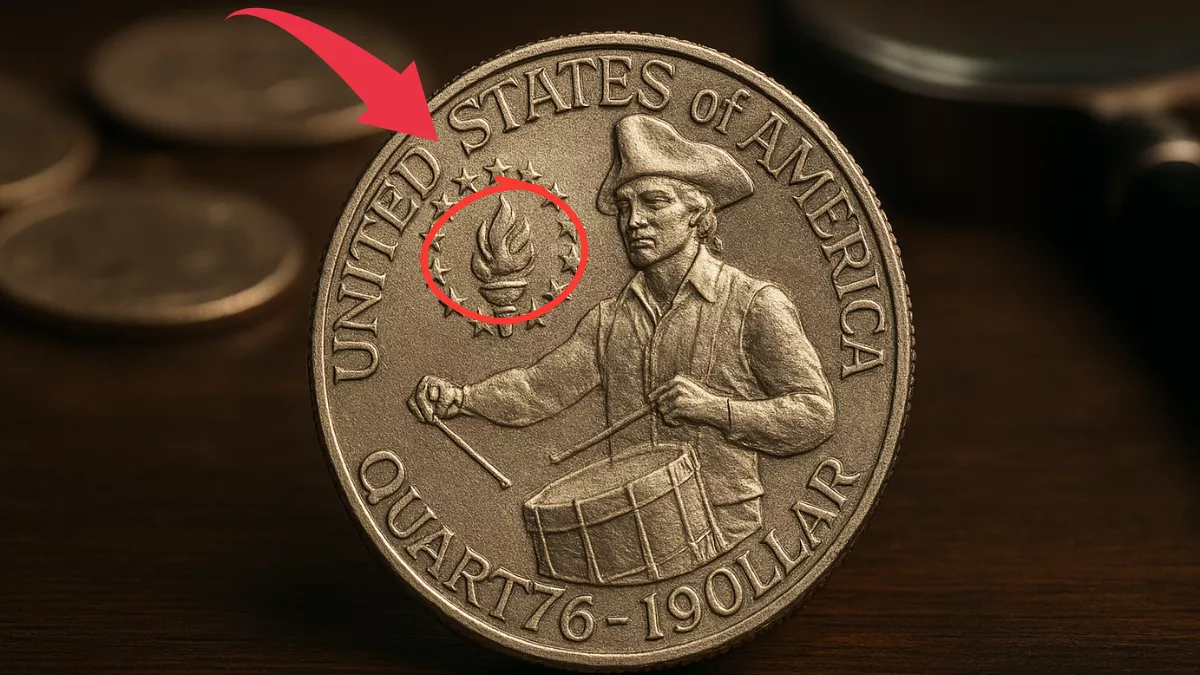

In 1976, America threw a birthday bash 200 years in the making and the U.S. Mint made sure the celebration jingled in everyone’s pocket. That’s where the Bicentennial quarter comes in. Issued to mark the nation’s 200th birthday, the coin wasn’t just patriotic—it was historic, artistic, and, for some collectors today, potentially very valuable.
Lately, a swirl of online chatter has claimed that a 1976 Bicentennial quarter is worth $4 million. Wild, right? While the headline has some grains of truth buried in a mountain of hype, there’s more to this story—and it deserves a closer, more grounded look.
The Quarter That Carried a Nation’s Pride
In the mid-1970s, the U.S. Mint did something it hadn’t done in decades: it changed the reverse design of circulating coinage. For the quarter, the traditional eagle was swapped for a striking new image—a Liberty Bell layered over the moon, a symbol of America’s historical grit and forward-looking ambition. The artist? Jack L. Ahr, whose design was selected through a public contest.
Every quarter minted in 1975 and 1976 bore the dual date “1776–1976”, even though none were dated solely 1975. They were produced in huge numbers—over 1.6 billion in total.
So if you’re holding a Bicentennial quarter right now, odds are it’s worth… well, 25 cents. But as with all things in numismatics, it’s the exceptions—not the norm—that bring in the big bucks.
1976 Bicentennial Quarter: Complete Snapshot
| Attribute | Details |
|---|---|
| Official Name | Washington Quarter, Bicentennial Reverse |
| Years Minted | 1975 & 1976 (All bear “1776–1976”) |
| Obverse Designer | John Flanagan (Washington design) |
| Reverse Designer | Jack L. Ahr (Liberty Bell with moon) |
| Metal Composition | 91.67% Copper, 8.33% Nickel (standard); 40% Silver for special editions |
| Weight | 5.67 grams |
| Mint Marks | None (Philadelphia), D (Denver), S (San Francisco) |
| Special Strikes | Circulation, Proof, 40% Silver Proof & Uncirculated |
So… What’s Up with the “$4 Million” Claim?
The short answer? It’s clickbait.

There’s no confirmed sale of a Bicentennial quarter—proof, silver, or otherwise—for anything remotely close to $4 million. Not at Heritage Auctions, not through PCGS, not even on eBay with a suspicious number of zeros.
Where the confusion starts is usually around error coins, proof coins in perfect grade, and silver strikes.
Here’s what can make a 1976 quarter valuable:
- Proof coins with the “S” mint mark, especially in 40% silver, that are in pristine, “deep cameo” condition.
- Error coins, like a doubled die obverse, off-center strike, or coins struck on the wrong planchet.
- High-grade circulation coins that score MS-67 or higher from professional grading services like PCGS or NGC.
Top auction prices for such coins? As of now:
- A 1976-S Silver Proof Quarter in PR70DCAM (deep cameo, perfect grade) might fetch $2,000–$5,000.
- A Mint State 1976-D quarter graded MS-68 sold for around $6,500 at auction.
- Rare error examples—off-metal strikes, double dies—can sell in the $10,000–$15,000 range, but those are outliers.
But $4 million? That’s pure speculation. Or someone adding a few extra zeros after too many cups of coffee.
How to Identify a Potentially Valuable Bicentennial Quarter
If you think you’ve got something special, here’s what to check:

1. Mint Mark
- Look just to the right of Washington’s ponytail.
- “S” = San Francisco (Proof or Silver versions)
- “D” = Denver
- No mark = Philadelphia
2. Edge Color
- A silver edge (no copper stripe) may indicate a 40% silver version.
- These were only sold in special sets, not released into circulation.
3. Condition
- Coins without any wear, scratches, or handling marks are much more desirable.
- Uncirculated examples may look freshly struck, with strong “frosting” on raised areas.
4. Errors
- Double die varieties
- Wrong planchet strikes
- Clipped planchets
- Off-center or misaligned strikes
If you suspect any of these, don’t guess. Have it professionally graded and authenticated.
Why Most Bicentennial Quarters Are Still Worth Face Value
Let’s be real: most of the 1.6+ billion quarters minted during the Bicentennial ended up in change jars, drawers, or vending machines. The fact they were mass-produced means most are common—very common.
Unless:
- It’s uncirculated
- It’s proof or silver
- It has a certified rare error
…then it likely won’t break the bank.
But that doesn’t mean it’s not meaningful. It’s a tangible slice of America’s 200th birthday. That alone gives it historical and sentimental value, even if it won’t buy you a Ferrari.

Collecting Tip: Silver vs. Clad Spot the Difference
| Feature | 40% Silver Bicentennial Quarter | Copper-Nickel Clad Quarter |
|---|---|---|
| Edge Color | Solid silver-gray | Copper-brown stripe visible |
| Mint Mark | Always “S” | “D”, “S”, or none |
| Sold In | Special mint sets only | Circulated & mint sets |
| Weight | Slightly heavier (~5.75g) | Standard 5.67g |
| Sound | Higher-pitched “ring” | Duller clink |
History First, Hype Second
Is a 1976 Bicentennial quarter worth $4 million? Almost certainly not. But is it worth something? Absolutely—if not financially, then culturally.
These quarters captured a moment when the country paused to celebrate itself. And unlike most commemorations, this one was built to circulate—to be touched, spent, and remembered. That’s powerful.
For collectors, the Bicentennial quarter is a gateway. It’s where a lot of folks start their coin journey. And once you learn to look for mint marks, study condition, and spot silver edges, you’re no longer just holding a coin—you’re holding a story.
FAQs
No. Most were heavily circulated and are still worth 25 cents. Value depends on condition, mint, and whether it’s silver or has a rare error.
Check the edge. No copper stripe? Possibly silver. Also, look for an “S” mint mark and verify it came from a special Mint set. A coin dealer can help confirm.

Only if it’s in perfect condition, shows signs of a mint error, or is a silver version. Grading costs money make sure it’s worth the investment.
It’s rare, but yes. Most are worn and worth face value, but sharp eyes occasionally spot gems.
So far, the highest publicly documented auction sale is around $6,500 for a high-grade Mint State coin not $4 million.
